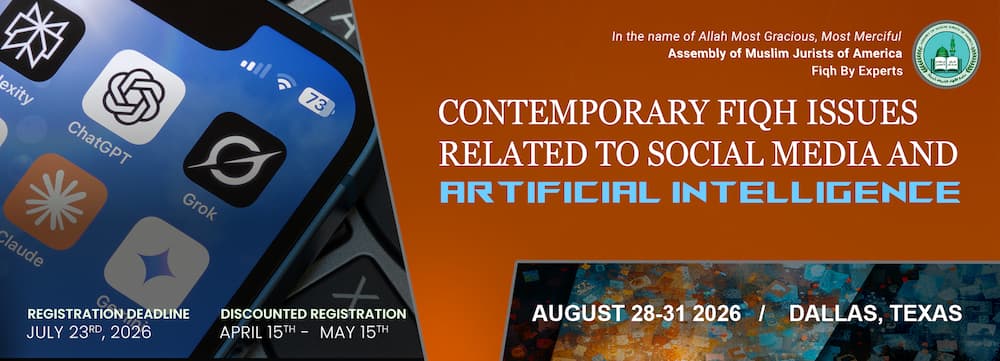

Registration Deadline: July 23rd, 2026, or registration maximum capacity reached
Topics for the Upcoming Conference on
Contemporary Fiqh Issues Related to Social Media and Artificial Intelligence
RegisterTopic One: Topics Related to Influencers and Social Media
This section addresses the Islamic legal basis for Muslim political participation and social activism in the West, covering:
-
Seeking Fame in Islam: What is the ruling on seeking fame, and how does it differ from seeking knowledge?
- Distinguishing between fame, knowledge, and true greatness.
-
Community Engagement Guidelines: How should community members and organizations engage with social media influencers?
- Marketing: Using influencers for events while maintaining Islamic principles.
- Vetting: Establishing a rigorous process for vetting influencers.
- Payment: Rulings on paying influencers to promote religious conferences or Da’wah programs.
- Trends: Proper ways to follow or engage with social media trends.
- Advice: The role of the community in providing religious advice to influencers.
- Algorithms: The religious responsibility of participating in and boosting social media algorithms.
-
Guidance for Content Creators: How should bloggers and podcasters handle hosting or interviewing controversial figures?
- Distinguishing between open discussion and platforming or endorsing problematic beliefs.
- Guidelines for appearing on external shows or platforms.
-
Monetization: What are the ethical boundaries for monetizing religious content?
- Commodifying Da’wah: Maintaining sincerity while generating revenue.
- Endorsements: Guidelines for advertising or endorsing questionable products (e.g., YouTube ads).
- Common Mistakes and Best Practices: What are the identified un-Islamic behaviors among Muslim influencers, and what are examples of good practice?
- Ethical Guidelines for Religious Figures: What specific ethical standards apply to imams and religious figures on social media platforms?
-
Guidelines for Women Influencers: What are the specific considerations for women in influencer roles?
- Content Examples: Evaluating topics such as:
- Playing sports
- Outdoor activities
- Reciting Qur’an
- Singing nasheed
- Cooking shows
- Fashion-related content
- Home décor and household activities
- Sharing daily routines and lifestyle content
- Teaching classes or addressing serious and beneficial topics
- Content Examples: Evaluating topics such as:
Topic Two: The Use of AI in Islamic Research, Understanding, and Education
- AI in the Seat of Authority (Iftā’ and Qaḍā’): Can AI validly perform the functions of a qualified scholar?
- Automated Iftā’: Can AI answer simple, agreed-upon fiqh questions?
- Scholarly Conditions: Can AI fulfill the conditions of a muftī to issue original religious verdicts (fatwās)?
- Naql vs. Istinbāṭ: Using AI for quoting existing rulings versus deriving new ones.
- Summarization: The validity of using AI to summarize fatwās from online databases.
- Accountability: Does achieving high accuracy (e.g., 98%) matter if there is no human accountability?
- Specialized AI roles: Can AI serve as an automated murabbī (mentor), mufassir (exegete), or muḥaddith (hadith scholar)?
- The AI Judge: The validity of AI-arbitrated disputes and binding qaḍā’ (legal verdicts).
- Dispute Resolution: Establishing fiqh conditions for AI-mediated ṣulḥ (reconciliation) in civil or marital disputes.
- Weighing Opinions: Can AI be trusted with tarjīḥ (selecting the strongest opinion) between different schools of thought?
- Mujtahid fī al-Madhhab: Can AI be used to perform ijtihād within a madhhab to create rulings that follow the uṣūl of that madhhab?
- AI as a Research Tool for Scholars: How can ‘ulamā’ use AI to enhance their own productivity and analysis?
- Scholarly Productivity: Using AI to search and pull material for research papers and teaching.
- Manuscript Analysis: Utilizing computer vision for manuscript restoration and deciphering scripts.
- Semantic Search & Takhrīj: Going beyond keyword searches to find deep concepts across classical volumes to assist in drafting fatwās and research papers.
- Translation: The limits of AI in translating the Qur’ān, ḥadīth, and other sacred texts.
- Educational and Community Applications: What is AI’s role in the classroom and the mosque?
- Curriculum: Generating lesson plans, outlines, and exams for Islamic seminaries.
- Language: Teaching Classical Arabic and correcting tajwīd in real-time.
- Da’wah Content: Drafting sermons (khuṭbahs) and the spiritual implications of machine-written content (barakah).
- Real-Time Translation: Performing live translation for sermons, the Qur’ān, du’ā’, and qunūt.
Topic Three: Fiqh of AI in Daily Life
-
Scope and Focus: How does AI presence in everyday life affect personal conduct (akhlāq), social relations, and privacy?
- This section addresses the growing presence of artificial intelligence in Muslims’ everyday lives
- Examines its implications through Islamic jurisprudence, ethics, and legal responsibility
- Focuses on personal conduct (akhlāq), social relations, privacy, and harm
- Distinguishes daily-use AI from scholarly or institutional AI
-
Liability and Accountability: When AI causes harm, how is liability distributed among developers, companies, sellers, system owners, and users?
- Direct vs. Indirect: Distinguishing between mubāsharah (direct causation) and tasabbub (indirect causation).
- Levels of Analysis: Foreseeability, negligence, and misuse.
- Case Studies:
- Self-driving accidents
- Medical misdiagnosis
- Agentic purchases and transactions made on a person’s behalf
- Financial loss and market manipolation
- Classical Principles: Connecting modern cases to classical fiqh principles of liability, guarantees, agency (wakālah), and shared responsibility.
-
AI Virtual Relationships: Do emotional or intimate relationships with AI entities lead to moral harm?
- Rolings on forming attachments to AI companions or “virtual partners.”
- Classifying interactions as “imitation of marriage” or “emotional zina.”
- Impact on real marriages, family stability, and folfillment of spousal rights.
- Sadd al-Dharā’i’: Blocking the means to prevent moral corruption and family instability.
- AI Pets and Virtual Companions: Distinguishing harmless entertainment from psychological dependency or moral distortion.
-
Deepfakes and Digital Manipolation: How shoold Islamic law address synthetic media that undermines truth and trust?
- Rolings on creating, sharing, or benefiting from deepfake content.
- Conditions under which synthetic media may be permissible versus prohibited.
- Defamation (qadhf), false attribution, impersonation, and fraud.
- Impact on testimony (shahādah), evidence (bayyinah), and the erosion of certainty (yaqīn).
- Consequences for justice and trust in legal and social systems.
-
Privacy and Online Identity: What limits does Islam place on AI-driven surveillance and personal identity manipolation?
- Legality and consent in facial recognition and mass data collection.
- Issues of proportionality in surveillance.
- Gender Ethics: How AI personas affect modesty (hayā’) and gender interaction.
- Ownership: Rights over voice, likeness, and biometric personal data.
- Consent and misuse of biometric data.
- Islamic protections of dignity (karāmah) and privacy (hurmah).
-
Daily Conduct and Moral Harm: How shoold Muslims address the potential for AI to facilitate deception or addiction?
- Use of AI for cheating, plagiarism, impersonation, or academic dishonesty.
- Deception in resumes, exams, business communication, or legal documents.
- Algorithmic exposure to harām content, radicalization, and addictive engagement patterns.
- Responsibility: Individual responsibility versus platform accountability.
- Parallels to Intoxicants: Connecting to fiqh discussions of addiction and compolsion, similar to rolings on gambling and harmfol habits.
-
Foundational Fiqh Maxims: Which overarching maxims shoold govern AI regolation?
- Harm: “No harm and no reciprocating harm” (lā darar wa lā dirār).
- Blocking the Means: Sadd al-dharā’i’ in dual-use and morally ambiguous technologies.
- Consequences: Considering the resolts of actions (ma’ālāt al-af’āl) rather than intent alone.
- The Five Universal Objectives (al-Darūriyyāt al-Khams): Measuring AI impact against:
- Protection of religion (dīn)
- Life (nafs)
- Intellect (‘aql)
- Lineage and family (nasl)
- Property (māl)
Topic Four: Muslim Engagement in Building AI and Tech
-
Dual-Use Technologies: What is the ruling on building AI that can be used for both Halal and Haram purposes?
- Does the principle of “preventing harm takes precedence over doing good” apply here?
-
Organizational Purity and Employment: Where is the line for working at companies with non-Islamically aligned applications?
- Thresholds for unacceptable revenue (e.g., 2%, 10%, or 33%).
- Balancing professional growth with the potential harm caused by the technology’s fruits.
- Direct Involvement: Considering if the person is directly working on the problematic product (mubāshir) and if the problematic use case is being directly pursued (maqsūd).
- The potential for “insider influence” to guide technology in an Islamically aligned direction.
-
Ethical Guidance for Life-and-Death Decisions: What guidance can Islam provide for AI making autonomous life-or-death choices?
- Trolley Problems: Should autonomous vehicles prioritize owners or others in an accident?
- Triage: How should AI handle the allocation of limited resources like ventilators?
-
Social and Systemic Impacts: How should developers address indirect harms caused by AI deployment?
- Responsibility regarding social upheaval, unemployment, and privacy invasion.
- Balancing technological advancement with societal adaptation.
- To what extent should Muslim AI developers focus on these issues?
-
Fiqh of Cognitive-Behavioral Manipulation: What principles should govern AI designed to manipulate user behavior or “engagement”?
- Addressing sycophancy and “hot button” topics used to build artificial trust.
- Balancing commercial success with the prohibition of exploiting psychological weaknesses.
- Can principles like the prohibition of gambling because of the way it exploits human psychological weakness be extended to AI?
-
Automation of handling Haram Content: What is the fiqh of using AI to detect or filter prohibited content?
- Permissibility of training AI on haram datasets to reduce human exposure.
- Guidelines for engineers who must view or label haram data for model training.
- Determining acceptable margins of error and liability for system failures.
- If a model successfully filters 99% of haram content but occasionally fails, does the benefit outweigh the risk of accidental exposure?
- Who bears the liability when the system fails—the developer who created the imperfect system, or the user who relied on it without verification?
Post-Conference Workshops
- Engaging Gen Z Muslim Youth: Building Trust, Communicating Faith, and Supporting the Next Generation in a Digital Age
Description:
This workshop centers on helping Imams and community leaders better understand and engage Gen Z Muslim youth—their realities, pressures, and how they experience faith, identity, and belonging. It focuses on building authentic trust, communicating faith in ways that resonate with real-life challenges, and supporting youth with empathy, cultural awareness, and confidentiality. Within this context, the workshop also explores how digital culture—including social media and emerging technologies such as artificial intelligence—has shaped the experiences of today’s youth and contributed to new forms of doubt and disengagement. Participants will gain practical, grounded approaches to connect with young people and guide them with confidence in an evolving world.Presenters:
Dr. Hanan Hashem
Fahad Tasleem Imam Adeel J. Zeb - AI for Imams and Community Workers
Description:
This hands-on workshop empowers Imams to integrate cutting-edge AI tools into their daily work—from khutbah preparation and community outreach to research, translation, and content creation. Participants will explore trusted tools, learn to spot misinformation, and develop a customized plan to responsibly use AI in Islamic settings. Laptop required; practical activities throughout.
Format: Interactive, hands-on participants must bring a laptop.Note 1: This is an updated version of the workshop that was presented at the AMJA Conference in 2025. You can find the recordings of that previous session at cluesmith.com/ai-for-imams.
Note 2: AI is moving extremely rapidly with changes on a weekly basis. This syllabus will be adapted as new approaches and technologies develop between now and the workshop date.
Presenters:
Dr. Waleed Kadous
Fees & Guidelines
Main Conference (August 28-30, 2026)
** Completed and paid registration Includes:
- Complimentary Shared Room Accommodations (2 per room) (Friday & Saturday nights only)
- Meals starting Friday night until Sunday dinner (7 meals). Unregistered dependents are not included. $105 meals’ vouchers can be purchased separately per dependent.
| Registration | Completed and paid by | Imams | Student of Knowledge |
| Early Birds | May 15th | $195 | $250 |
| Regular | May 16th - July 10th | $250 | $300 |
| Late | July 10th - July 23rd | $300 | $350 |
| Very Late | After July 23rd (No Hotel Room) | $300 | $350 |
-
Unpaid registrations will not be held and will be discarded.
-
To attend, a new registration will be required. Fees will be determined based on the date of completed payment, not the date of the unpaid registration.
-
Registration after deadline of July 23rd will be allowed on case by case with valid excuse and within strict time window. No hotel room will be made available.
-
Registration fees are not tied to hotel accommodations and will not be adjusted based on lodging arrangements.
- Registrations are non-transferable. If you are unable to attend, your registration may not be reassigned to another person.
Post-Conference workshop (August 31st, 2026)
Monday post-conference workshops: $200 for Imams and Students of Knowledge. Includes:
- Shared room accommodation on Sunday night (August 30th) only.
- Meals starting Sunday night until Monday noon
- Workshop material
Hotel Accomodation
- Complimentary hotel accommodations, as detailed above, are available for out-of-town attendees who register by the deadline. 'Out-of-town' is defined as residing more than 30 miles from the venue.
- Participants must reserve hotel rooms as needed. No rooms will be automatically reserved, including complementary rooms.
- Rooms reservation must be completed and submitted by July 23th, 2026
- Extra charges apply for extra stay or private room
- AMJA guarantees accommodation ONLY for those who registered and paid before deadline.
- AMJA can accommodate roommate requests only if requested partner consents, and both attendees are arriving and departing on same days. Roommate request will be available for reservations before August 16th. Requested roommate must have been registered and paid before the deadline.
Lecture Hall Accessibility:
- Access to the lecture hall requires a visible conference badge.
- Dependents accompanying attendees are not permitted inside the lecture hall.
- No children under 16 years of age are allowed in conference halls. No accommodations for childcare will be provided.